In a world that constantly pushes us to be happy, successful, and “positive,” courage is often misunderstood.
We associate courage with bold actions—quitting a job dramatically, starting a company, standing on a stage, or facing extreme danger. These moments are powerful, but they are rare. And more importantly, they are not where most of life happens.
Most of life happens quietly.
It happens in ordinary days filled with uncertainty, routine, emotional ups and downs, and unanswered questions. And it is in these moments—not the dramatic ones—that courage becomes the most important force in our lives.
This is where a deeper understanding begins: courage is not about intensity; it is about consistency.
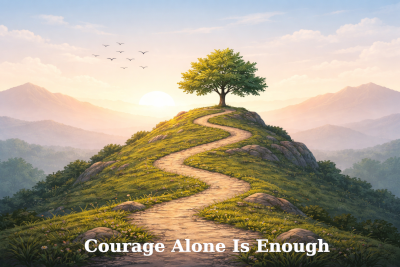
What Courage Really Means
Courage is not the absence of fear. It is the ability to move forward despite fear.
Fear is natural. Doubt is natural. Confusion is natural. Trying to eliminate them is like trying to stop the wind—they are part of being human.
Courage doesn’t fight these experiences. It works alongside them.
It says:
- “I don’t feel ready, but I will begin.”
- “I don’t feel confident, but I will try.”
- “I don’t know the outcome, but I will take the next step.”
This subtle shift changes everything. Instead of waiting for the perfect internal state, you begin acting in imperfect conditions. And that is where real growth begins.
The Trap of Positive and Negative Thinking
We are conditioned to divide life into two categories:
- Positive experiences we want to hold on to
- Negative experiences we want to avoid
At first glance, this seems logical. But this mindset creates an invisible trap.
When we depend on positive experiences to feel good, we become fragile. The moment life turns difficult—as it always does—we feel lost, frustrated, or even defeated.
On the other hand, when we resist negative experiences, we unintentionally give them more power. We spend energy avoiding discomfort instead of learning how to move through it.
Courage offers a different path.
It allows you to step beyond this constant evaluation of “good” and “bad.” Instead of reacting to every situation emotionally, you begin to respond with stability.
You realize:
- A bad day doesn’t define your life
- A good day doesn’t guarantee your future
- And neither should control your direction
This is where inner peace starts—not by controlling life, but by changing your relationship with it.
Courage as a Daily Practice
Courage is not a one-time act. It is a daily practice.
It shows up in small, often unnoticed decisions:
- Continuing your work when motivation disappears
- Staying patient when results are slow
- Choosing discipline over comfort
- Speaking honestly when it would be easier to stay silent
- Taking responsibility instead of making excuses
These actions don’t feel heroic. In fact, they can feel repetitive and even boring.
But they are powerful because they build momentum.
Over time, these small acts of courage compound. They shape your habits, your mindset, and ultimately your life.
When Life Feels Uncertain
There are phases in life where nothing feels clear.
You may not know:
- What you truly want
- Whether you are on the right path
- If your efforts will ever pay off
This uncertainty can feel uncomfortable. Many people respond by either overthinking or giving up.
Courage offers a third option: keep moving without needing all the answers.
You don’t need a perfect plan to take a step.
You don’t need certainty to make progress.
Clarity often comes after action, not before it.
By continuing forward, even slowly, you create your own direction.
The Connection Between Courage and Peace
Most people chase peace by trying to control life:
- They want stable outcomes
- Predictable results
- Constant positivity
But life is unpredictable by nature. No amount of planning can remove uncertainty completely.
This is why peace feels temporary when it depends on external conditions.
Courage changes this dynamic.
When you develop courage, you no longer rely on life being perfect. You become capable of handling whatever comes—success or failure, happiness or difficulty.
This creates a deeper form of peace.
Not the fragile peace that depends on everything going well,
but a stable peace that exists even when things don’t.
Courage in Difficult Moments
Courage becomes most visible during hard times.
Not as dramatic strength, but as quiet persistence.
It is:
- Getting up after repeated failures
- Continuing despite criticism or lack of recognition
- Holding on when progress feels invisible
- Choosing not to quit, even when quitting feels justified
These moments test you, but they also shape you.
Every time you choose courage over avoidance, you strengthen your ability to face future challenges.
And gradually, what once felt overwhelming becomes manageable.
You Don’t Need to Be Extraordinary
One of the biggest misconceptions about courage is that it is reserved for extraordinary people.
It is not.
Courage is available to anyone willing to take one step forward, regardless of how they feel.
You don’t need:
- Perfect confidence
- A flawless plan
- Endless motivation
You only need willingness.
Willingness to try.
Willingness to continue.
Willingness to face discomfort.
That is enough.
A Practical Way to Start
If you want to bring more courage into your life, start simple:
- Identify one thing you’ve been avoiding
- Break it into the smallest possible step
- Take that step today—without overthinking
It could be:
- Writing one page
- Making one call
- Learning one concept
- Fixing one mistake
The goal is not perfection.
The goal is movement.
Each small step reinforces a powerful identity:
you are someone who moves forward, no matter what.
Final Thoughts: Courage Is Enough
Life will not always go as planned.
There will be setbacks, confusion, and moments where nothing makes sense.
In those moments, you don’t need to have all the answers.
You don’t need to feel strong.
You don’t need to feel positive.
You only need courage.
Because courage keeps you moving when everything else fades.
It keeps you grounded when emotions fluctuate.
And it allows you to build a meaningful life—not by controlling circumstances, but by responding to them with strength and clarity.
If this perspective resonates with you, “Courage Alone Is Enough: Finding Peace and Happiness Beyond Positive and Negative Events” explores these ideas more deeply. The book expands on how courage can become a steady foundation—not just in big decisions, but in everyday life.